
The Session Where Tilt Cost Me More Than the Pot
It's 11:40 p.m. on a Tuesday and I'm staring at a pot I've already lost, mentally, about four seconds before the river card even lands. Third barrel, ace-high board, and I've turned a marginal bluff-catch into a full stack-off because the guy three-bet me twenty minutes earlier and I never let it go. That's poker tilt in its purest form — not rage, not tears, just one bad beat quietly rewiring every decision after it. I've played this game long enough to recognize the pattern from the outside. Recognizing it from inside my own head, in real time, is a completely different skill, and that night I didn't have it.
I'd been running fine for two hours at NL200 6-max, up about 3 buy-ins, playing the tight-aggressive game that actually pays my rent. Then a guy who'd been folding for twenty orbits woke up with kings and stacked my aces. Clean cooler, nobody's fault, the kind of hand you're supposed to shrug off in about ninety seconds. I didn't shrug it off. I sat there replaying the hand while three more hands were dealt to me, and I played all three of them like I was still trying to win that pot back. My stack went from up 3 buy-ins to down 2 in the space of maybe eleven minutes, and I can tell you almost nothing useful about the two hands in between the cooler and the one below, because I wasn't really watching the table. I was watching the memory of the kings.
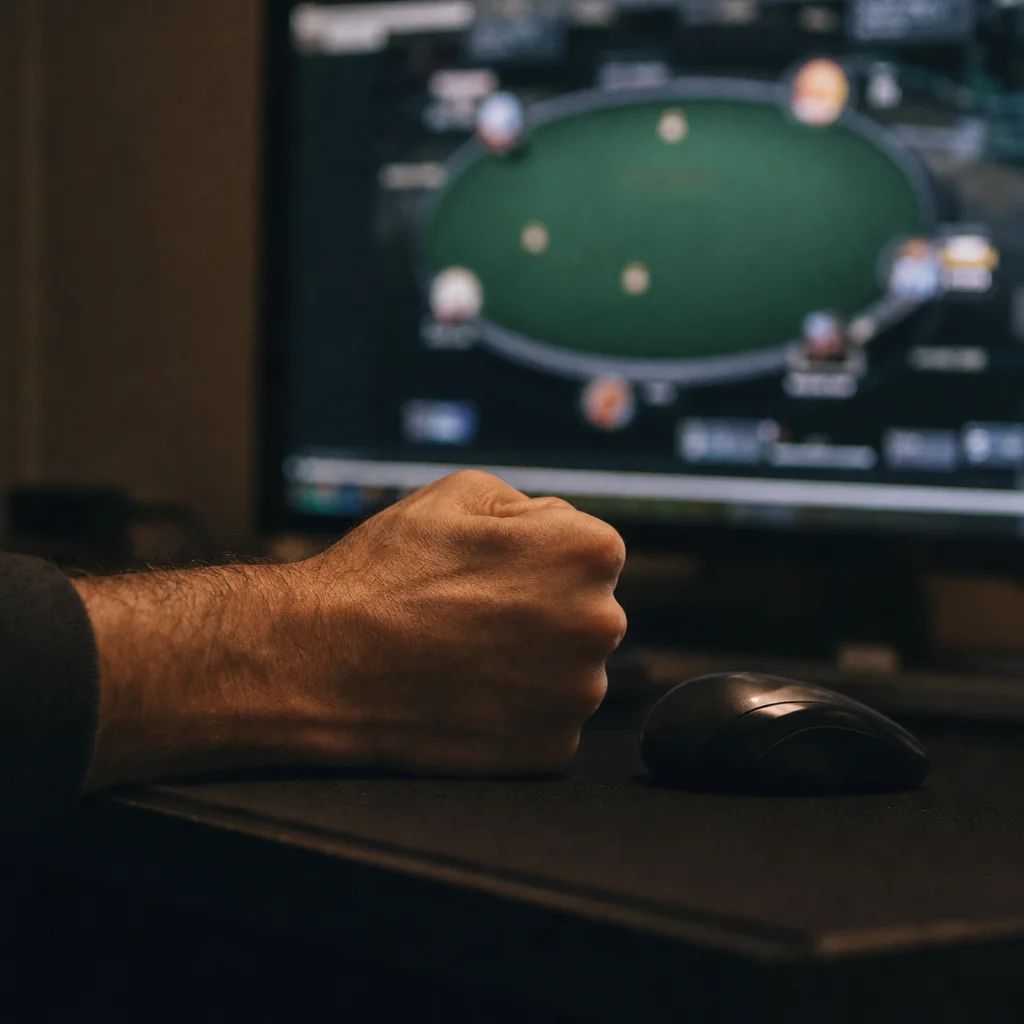
- PREFLOP
I raise A9 suited from the hijack, the same guy who cracked my aces calls from the button. I'm already telling myself this hand means something.
- FLOP
Ace high, top pair weak kicker. I bet two-thirds pot on autopilot, not really thinking about his range, just wanting to be the one doing damage this time.
- TURN
King falls, no help to me, and I barrel again anyway. This is the bet I can't defend — I'm betting my own frustration, not my hand.
- RIVER
I pick up a flush draw that misses on a blank-looking heart, decide I'm 'pot committed' to a river I invented myself, and jam for my last 22 big blinds. He snap-calls with two pair and shows it face up before I even muck.
Lost 38 BB, on top of the 30 BB cooler two hands earlier.
Mistake: Three separate mistakes stacked on top of each other — the flop c-bet without a plan, the turn barrel for revenge instead of value, and the river jam on a hand that had no business being pot committed.
Correct line: Check back the turn, maybe even the flop, and let a marginal top pair see a cheap showdown against a range that had already shown it could have kings.
That's the part that actually stings, looking back at the hand history. It wasn't one bad decision. It was three, each one built on the last, and every one of them explainable only if you already know what poker tilt meaning looks like from the inside — you're not aware you're doing it. You think you're 'getting your money in good.' You think the guy is bluffing again. You think this is the hand where it turns around. None of that was true. I was on tilt, and I stayed on tilt for four hands because I didn't have a rule that forced me to stop. What's strange is that on paper, in the cold light of the next morning, every single one of those decisions looks obviously wrong. In the moment, each one felt like the only sane read available.
I've read enough about being poker on tilt to know poker tilt control isn't really about willpower in the moment — by the time you're deciding whether to keep playing, the decision-making part of your brain is already compromised. The fix has to exist before the session starts, not during it. That night I had no stop-loss, no timer, no rule. I had a vague sense that I 'should probably take a break soon,' which is the least effective thought a tilting player can have, because it always loses to 'just one more hand to get it back.' I've since talked to a couple of regs at these stakes who swear they can spot themselves tilting by a physical tell — clenched jaw, faster clicking, whatever. I've tried to use that as an early warning system myself, and I'll be honest: it's caught maybe one session in three. The other two, I was three hands deep before I noticed anything physical at all, which is exactly why I don't trust a tell as a standalone plan. (see tilt (poker)).
Poker tilt doesn't cost you the pot you're in — it costs you the three hands you play afterward trying to fix it.
The rule I built out of that night is boring, which is exactly why it works: two buy-ins down in a session and I close the client, no exceptions, no 'but I'm running bad, not playing bad.' I don't trust myself to tell the difference at 11:40 p.m. anymore, and honestly, I'm not sure I ever could. I still break the rule sometimes — I'd be lying if I said a hard stop-loss cured me of being on tilt entirely. What changed is that now it happens less often, and it costs me one buy-in instead of two. The spreadsheet backs that up too: in the six months before I wrote the rule down, my worst sessions averaged close to three buy-ins lost. In the six months after, that number dropped to just over one. Same skill level, same game, same variance. The only thing different was a line I wasn't allowed to cross. (see BeGambleAware).
If you want the actual daily version of this — the routine that's supposed to catch a session like that before it happens — that lives over on my mental game notes, not here. And if you're the type who wants the math on why one bad session shouldn't rattle you long-term, the variance breakdown is its own piece too. This entry is just the one night that taught me the rule existed for a reason, and I still go back and reread the hand history sometimes, mostly to remind myself what the third barrel looked like right before I fired it.