
Online Poker Winning Strategy: What Actually Moved My Graph
An online poker winning strategy isn't one clever trick or a solver line you memorize before a session — it's a repeatable process around table selection, volume, and how you adjust between cash games and tournaments. I've spent six years building mine, mostly by getting it wrong first. If you want to see how I log the actual sessions behind this process, keeping this journal is one of the tools I use to keep the numbers honest rather than trusting my memory of how a week went.
Why Table Selection Comes Before Any Hand
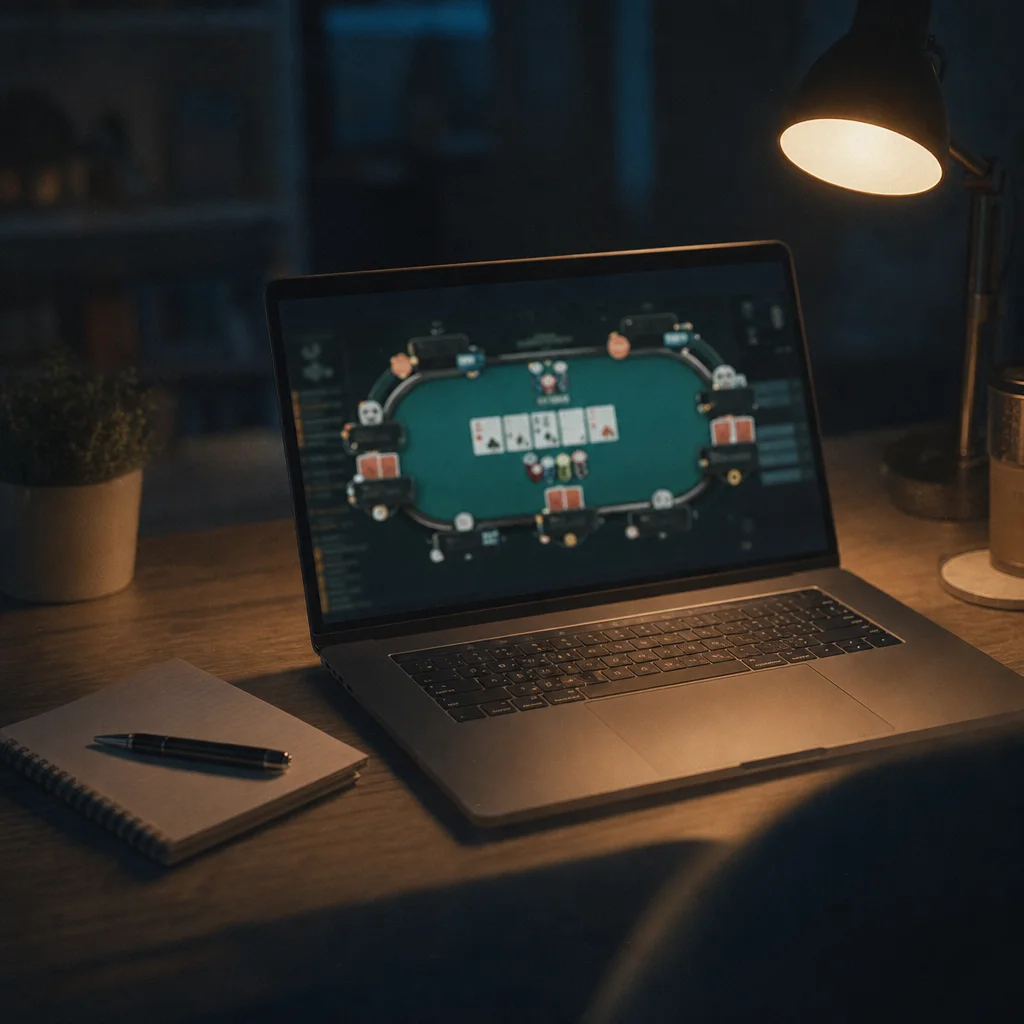
I used to sit down at whatever table had a seat open. That's backwards. Table selection is the single biggest lever in any online poker winning strategy, above any preflop chart or bet-sizing rule you'll read this year. A soft table with three limpers and one maniac earns more per hour than a tough table played perfectly.
Now I check average pot size and players-per-flop before I click join. If those numbers are low and the waiting list is full of regs, I leave. It's not glamorous, but it's the adjustment that's paid me the most across every stake I've played.
I keep a simple filter now: three or more limpers per orbit, or an average pot over 15 big blinds, and I'll sit. Anything tighter, and I'm hunting a different table before I've even seen a hand dealt. It sounds mechanical, but that's the point — I don't trust my gut to make this call after a long day.
Volume: How Many Hands Actually Builds a Sample
Online tables deal roughly 60-80 hands per hour on a single table, and multi-tabling four tables can push that past 250 hands per hour. That volume is both the advantage of online poker and the trap — a bad run of 3,000 hands can still be pure variance, not a leak, and a good run can hide one.
I track hands played weekly, not daily, because daily numbers swing on nothing. Once I'm past roughly 20,000-30,000 hands at a stake, my win rate starts telling me something real instead of noise. Before that, I try not to draw conclusions from a single week, however good or bad it felt.
Cash Games: Tips for Online Poker Cash Games That Hold Up
Cash game strategy rewards patience over aggression for most winning regs at low and mid stakes. The biggest tips for online poker cash games I'd actually stand behind: play fewer tables than you think you can handle, widen your range in position and tighten it out of position, and stop treating every session as a referendum on your skill.
One habit that changed my results: reviewing hands the next day instead of mid-session. In the moment I'm too attached to the outcome. A day later, I can see the fold I should've made without the sting of the river card still fresh.
I also stopped treating every session like it needed a verdict. Some nights I'm up 3 buy-ins and played worse than the night I lost 2. The graph and the decision quality aren't the same thing over a few thousand hands, even though it feels like they should be.
Online Poker MTT Strategy: Adjusting for Stack Depth
Tournament play is a different animal, and an online poker mtt strategy that copies cash game logic will bleed chips. Stack depth changes everything — at 25 big blinds you're making push-fold decisions far more than you are at 100 big blinds deep. ICM pressure near the bubble also means some cash-game-correct calls become clear folds.
My biggest MTT adjustment was slowing down late registration. I used to fire every flip in the first level. Now I wait, watch stack sizes build, and pick softer starting tables — the same table selection principle from cash games, just applied to a shrinking field.
Online Poker Tournament Tips for the Middle Stages
The middle stages of a tournament are where most of my equity gets built or lost, and they're the least talked-about phase. My core online poker tournament tips here: apply pressure on medium stacks who are scared of busting, and avoid confrontations with the two or three biggest stacks unless you have a genuine hand.
I still catch myself wanting to gamble in spots I shouldn't, especially after a cooler. That's a tilt-management problem more than a strategy one, and I've written about how I actually handle that on the table in more detail on the mental game page — this piece is about the process around the cards, not what's happening in my head.
Somewhere around this stage of a session I usually pull up my log to check whether I'm actually playing my usual volume or just feeling busy. If you want a simple way to see that pattern across weeks instead of guessing, a session log like this one is one option — a plain spreadsheet works too, as long as you actually open it.
Best Tips for Online Poker: What I'd Tell a Newer Grinder
If I had to compress the best tips for online poker into a handful of lines, they'd sound almost boring: pick soft tables on purpose, track your volume in real hands not vibes, separate cash and tournament adjustments instead of blending them, and review losing sessions as carefully as winning ones.
None of that requires a subscription or a course. It requires a spreadsheet, or a proper poker journal, and the discipline to actually fill it in after a bad night. A plain notes app never stuck for me, but a dedicated poker tracker or even a structured spreadsheet template does the job just as well if the format fits you better.
- Check average pot size and players-per-flop before joining any table
- Track hands weekly, not daily, to avoid reacting to noise
- Play fewer tables than you're capable of, especially at a new stake
- Slow down MTT late registration instead of firing every early flip
- Review losing sessions the next day, not mid-session
Live Poker Strategy: What Transfers From the Online Grind
A live poker strategy built purely on online habits will misfire without adjustment. Live players limp more, bluff less often, and give away far more information through timing and bet sizing than any online reg does. The table selection instinct transfers directly — a live table full of recreational players is worth more than a tough online table at the same stakes.
What doesn't transfer is the pace. Live poker deals maybe 25-30 hands an hour at a full table, so a losing live session tells you almost nothing statistically. I remind myself of that every time I play live and start second-guessing a fold from three hours earlier.
On Bankroll Sizing
Crushing Low Stakes With Exploitative Poker
Learning how to crush low stakes poker mostly comes down to exploiting the obvious. Low stakes regulars fold too much to continuation bets, call too wide preflop, and rarely bluff big rivers. You don't need balance at these stakes — you need to notice patterns and hammer them, and stop once a table gets tougher than it's worth.
This is also where exploitative poker earns its keep over a pure game-theory-optimal approach. Playing exploitative poker means deviating from balanced ranges to attack a specific player's tendency — over-folding to 3-bets, say — and it works best exactly where opponents are weakest: low and micro stakes, not against solid mid-stakes regs.
At NL25 and below, I've found most regs simply don't defend their big blind wide enough against steals, and most recreational players call one street too many with a weak pair. Neither read needs a solver to exploit — it needs a stat window open and the patience to confirm it over more than a session or two.
The risk with exploitative poker is reading too much into a small sample and adjusting off a tell that only holds up some of the time. I've bluffed off a stack assuming a player always folds to river raises, based on maybe four hands, and been wrong. A read needs volume behind it before I'll bet real money on it.
So my rule now: exploit patterns I've seen repeated across a session or several sessions against the same player, not a single hand. Against unknowns, I default to a more balanced, standard line until the sample says otherwise.
If you're just getting started and wondering how to learn online poker in the first place, the honest answer is small stakes, small samples, and patience — start at the lowest real-money tables or free tables, play a few thousand hands before judging results, and resist the urge to move up after one good week. How to practice online poker away from the table matters just as much: reviewing hand histories, running spots through a solver occasionally, and reading one solid strategy book beats hours of unreviewed autopilot play. (see poker probability).
None of this is a finished system. I still misjudge tables, still play too many late-reg flips when I'm bored, and I'll probably rewrite half of this in a year once more hands change my mind. What's worked is treating the process as more important than any single session — table selection first, volume tracked honestly, cash and tournament adjustments kept separate, and reads held to a real sample before I act on them.
Want to Log Your Own Sessions?
A simple way to track hands, stakes, and results without relying on memory.
See NZT PokerDisclosure: This page contains affiliate links. We may earn a commission at no extra cost to you.